Showing posts with label health and happiness. Show all posts

Thursday, May 22, 2025

PSYCHOSPIRITUAL DYNAMICS AT MIDLIFE AND BEYOND - Guideposts for a Healthy and Happy Second Half of Life.

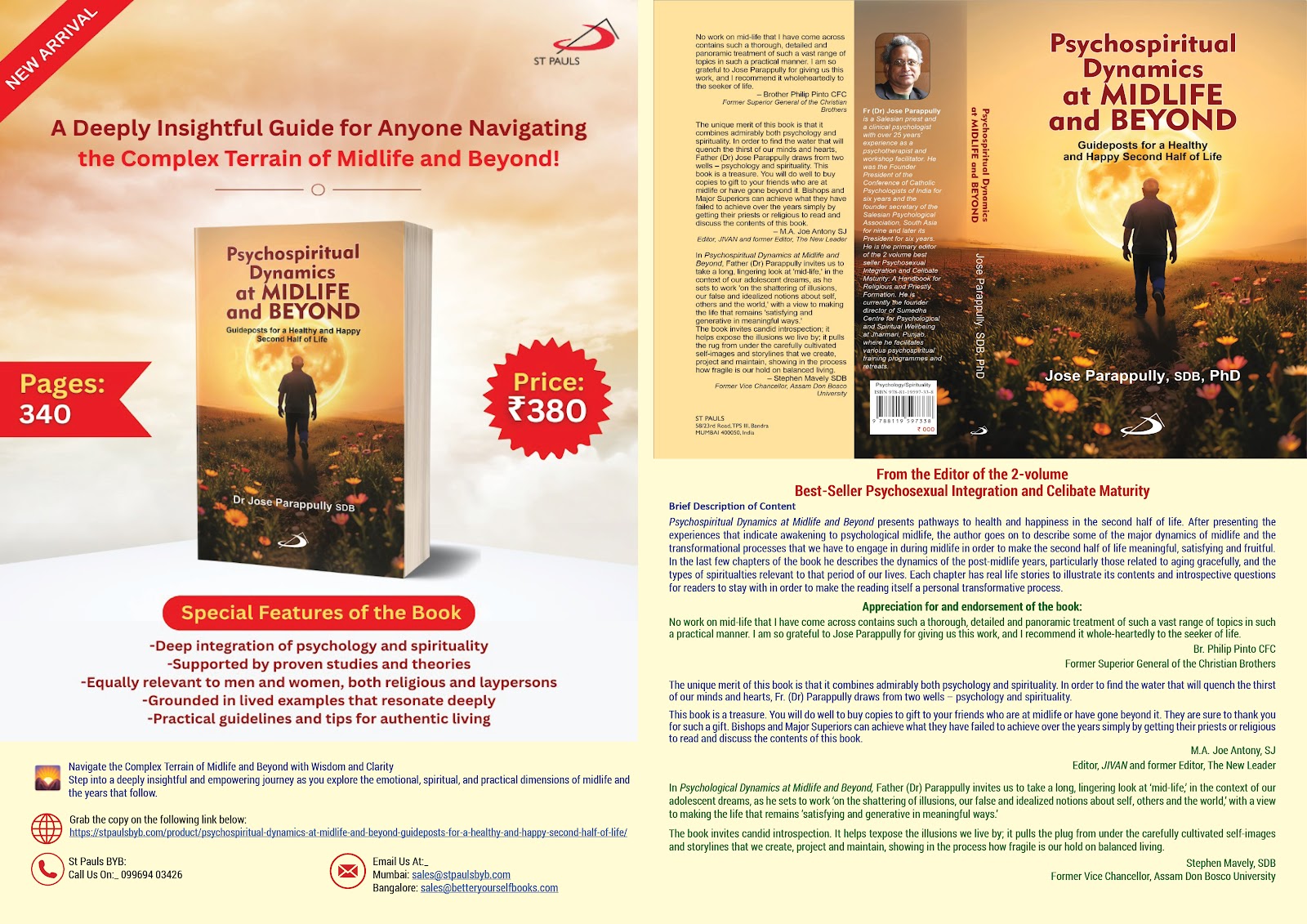
 I am very happy to introduce  a  new book I have authored and  published by St. Paul's on Psychospiritual Dynamics at Midlife and Beyond. 


Brief Description of Content

Psychospiritual Dynamics at Midlife and Beyond presents pathways to health and happiness in the second half of life. After presenting the experiences that indicate awakening to psychological midlife, the author goes on to describe some of the major dynamics of midlife and the transformational processes that we have to engage in during midlife in order to make the second half of our life meaningful, satisfying and fruitful. In the last few chapters of the book he describes the dynamics of the post-midlife years, particularly those related to aging gracefully, and the types of spiritualties relevant to that period of our lives. Each chapter has real life stories to illustrate its contents and introspective questions for readers to stay with in order to make the reading itself a personal transformative process.


Appreciation for and endorsement of the book

No work on mid-life that I have come across contains such a thorough, detailed and panoramic treatment of such a vast range of topics in such a practical manner. I am so grateful to Jose Parappully for giving us this work, and I recommend it whole-heartedly to the seeker of life.

Br. Philip Pinto CFC

Former Superior General of the Christian Brothers


The unique merit of this book is that it combines admirably both psychology and spirituality. In order to find the water that will quench the thirst of our minds and hearts, Fr. (Dr) Parappully draws from two wells – psychology and spirituality.

This book is a treasure. You will do well to buy copies to gift to your friends who are at midlife or have gone beyond it. They are sure to thank you for such a giftBishops and Major Superiors can achieve what they have failed to achieve over the years simply by getting their priests or religious to read and discuss the contents of this book.

M.A. Joe Antony, SJ

Editor, JIVAN and former Editor, The New Leader


In Psychological Dynamics and Midlife and Beyond, Dr Parappully invites us to take a long, lingering look at ‘mid-life,’ in the context of our adolescent dreams, as he sets to work ‘on the shattering of illusions, our false and idealized notions about self, others and the world,’ with a view to making the life that remains ‘satisfying and generative in meaningful ways.’


This book invites candid introspection; it helps expose the illusions we live by; it pulls the plug from under the carefully cultivated self-images and storylines that we create, project and maintain, showing in the process how fragile is our hold on balanced living.


Stephen Mavely, SDB

Former Vice Chancellor, Assam Don Bosco University


the book is available from St. Paul's Book Stores in most towns and cities and online at the link below:

St Pauls BYB:
Call Us On: 099694 03426

Friday, September 11, 2020

Psyche & Soul - 11: SELF-ACCEPTANCE

 Podcast Link:

https://anchor.fm/boscom/episodes/2-11-Psyche--Soul---Self-Acceptance-29-ejf4n3


SELF-ACCEPTANCE

“Acceptance of oneself is …the acid test of one’s whole outlook on life. C.G. Jung

Hello, this is Jose Parappully, Salesian priest and clinical psychologist at Sumedha centre, Jeolikote, with another edition of Psyche & Soul.

This weekend we shall focus on Self-Acceptance which is a foundational requisite for emotional health and happiness.


Self-acceptance, as the great psychologist Carl Jung points out, is not only an essential requisite for emotional wellbeing, but also influences our way of being in the world. In his own words: “Acceptance of oneself is …the acid test of one’s whole outlook on life.

However, many of us find self-acceptance a big challenge. This was the case with Anjana. Let us listen to what she says about herself.

“I don’t like myself. Actually, I hate myself. I hate my body. I hate the person I have become. I get angry so often. I shout and scream at people. I am not very successful in much of what I do and get blamed so often.” She seems angry and disgusted with herself.

It’s hard to accept oneself, and more so to love oneself, when we are confronted with so many of our frailties and weakness. Yet, if we want to be emotionally healthy persons, we need to accept the whole of ourselves without rejecting any aspect of our being: body, gender, sex, mind, limitations and weakness, strengths and talents, and our personal and family histories.

Self-acceptance is based on genuine knowledge of self, grounded in realistic appraisal of our resources and limitations. This knowledge comes also from what others are saying about us.


Manifestations of Self-Acceptance

When we accept ourselves, we have genuine appreciation for our own worth, and we do not engage in irrational self-reproach. We are happy with who we are, and do not feel the need to boast of our accomplishments or to inflate them.

 We are willing to admit faults and failures without embarrassment, rather than trying to cover up or deny. We are willing to accept corrections.

 When we accept ourselves like this others too will find it easy to accept us and relate to us, since we do not feel any compulsion to hide or defend our mistakes, or to boast of our talents or achievements

 A corollary to this self-acceptance and self-appreciation is the ability to allow others the right to be themselves. We are able to accept others as they are with their flaws and limitations. We do not impose our own views, expectations or needs on others. Neither do we feel the need to put others down or downplay their achievements.  We are not threatened by the beauty, giftedness or achievements of others; rather we are able to rejoice with them and speak appreciatively about them to others. 


Manifestations of Self-Rejection

Self-rejection, on the contrary, shows itself in the following unhealthy forms of behaviour: chronic self-disapproval and self-disparagement; feelings of being unworthy; excessive guilt; pretending to be who/what we are not, going out of the way to boast or impress others; feeling others are against us, view us unfairly, or don’t understand us.

When we do not feel good about ourselves, when we lack self-esteem, we may try to over-control our environment. We become overcautious about making mistakes. We feel the need to do everything right and perfect. This can lead to Obsessive Compulsive Personality Disorder.

Lack of self-acceptance often results in scrupulosity. Because of the fear of rejection by others and especially by God, we tend to become perfect by striving to avoid even the least wrong doing. Since we reject ourselves because of our short comings, we tend to believe that others and God also will reject us if we are not “perfect.” Perfectionism deafens us to the good news that a loving God unconditionally accepts and loves us just as we are, that we don’t need to earn God’s love.


Challenging Situations

Self-acceptance becomes a challenge especially for women in the context of the relentless media pressure to conform to perfect body shape and appearance offered as ideal. These images tend to confirm self-doubts about goodness of one’s own body leading to a feeling of not being “good enough” and frenetic efforts to change one’s body shape and appearance to match the ideal. When one fails in the attempt one tends to live with a sense of deficiency. It is good to remember here that attractiveness and acceptance depend on more than just physical appearance.

Some of us have deformities or blemishes that affect our self-image and our capacity to function effectively or relate well. Remedial measures such as corrective surgery here is wholesome. However, often expensive cosmetic and surgical interventions are purely to allay our feelings of inadequacy and fears of non-acceptance by others, or simply to conform to ideal images of beauty, even when we are endowed with sufficient grace and beauty.


The Power of Self-Acceptance

The power of self-acceptance is demonstrated by the wonderful accomplishments of physically challenged athletes and artists. These men and women have disabilities that profoundly affect their mobility and other capacities.  However, they are able to accept their limitations and triumph over them and go on to win laurels.

Emotionally healthy persons are able to accept themselves as they are, with their deficiencies and their limitations. This acceptance is not resignation. One accepts, but also strives to overcome the limitations wherever possible.

Introspection

  • Am I able to accept myself, with my frailties and limitations, or am I like Anjana, rejecting and despising myself?
  • What is my challenge in regard to self-acceptance?

                                                                        ******


In Psalm 139 we read: “For it was you who created by being, knit me together in in my mother’s womb. I thank you for the wonder of my being, for the wonders of all your creation. (13-14).

We could stay with these words of the Psalmist, paying attention to the thoughts, images and feelings these evoke in us. We could then spend a few moments talking to God about whatever is arising within us. Allow God to lead us into recognising and loving the wonder of our being.

Have a pleasant weekend, where in you can recognize your beauty and goodness, and accept and love yourself the way God accepts and loves you.  

Be well. Be safe. Be blessed.

Jose Parappully PhD

Email: sumedhacentre@gmail.com


Thursday, August 27, 2020

Psyche & Soul 9 - LIVING WITH MEANING AND PURPOSE

 Podcast Link:

https://anchor.fm/boscom/episodes/2-9-Psyche--Soul---LIVING-WITH-MEANING-AND-PURPOSE-25-eip7u8

“I don’t find any meaning in my life. I wonder why I am living like this. Just dragging myself on from day to day. Sometime I wish I were dead” so said the 28-year old Sunita during a personal meeting with me at a seminar.


Sunita is not the only one who feels this way. There are many like her who find it difficult to experience a sense of meaning and purpose in life. Quite a few of these persons gradually sink into clinical depression and sometimes think of ending their life and even attempt to do so. This is very much true during these days of the Covid-19 lockdown, when things that gave meaning to one’s life may no longer be available.


Recent research on health and happiness show that a sense of meaning in life is one of the major contributors to emotional and physical wellbeing. Emotionally healthy persons find life a meaningful adventure. They have something that gives meaning and significance to their life, such as an ideology, a dream, a commitment. According to the pioneering personality psychologist, Gordon Allport, “one of the key challenges to maturity is to invest daily life with meaning—to find or create opportunities to make our lives matter”

Sonja Lyubomirsky, a psychologist who has researched happiness and wellbeing for over 25 years observes in her book “The How of Happiness” that having goals in and of themselves is strongly associated with health and happiness. Persons working toward a personally significant goal are far happier than those who do not have such dreams or aspirations. Having goals gives us a feeling of control over our lives and bolsters our self-esteem. It directly influences our physical and mental health. 


When we do not find purpose and meaningfulness, we become vulnerable to the onslaughts of ill-health, both physical and mental. However, when we have these, we can triumph over any tragedy. Viktor Frankl, a survivor of the horrors of the concentration camp at Auschwitz, has built up a whole philosophy around meaningfulness. What helped him to escape alive from Auschwitz, while almost all of his fellow inmates perished, was a dream he cherished: his determination to be with his wife again. While the others lost hope, his dream sustained him and enabled him to survive. A central message in his later writings is a quote from Nietzsche” “If you have a WHY to live for, you can live any HOW.” In other words, if we have meaning and purpose, something to live for, then we will face and triumph over any adversity. As the popular song “The Impossible Dream” from the musical “Man of La Mancha” says it: we can “march through hell for a heavenly cause.”  

Trauma and tragedy are part of the human condition. Those who have something to live for will find it much easier to triumph over these. They will be able not only to makes sense of these, but also create something beautiful out of them. Great artists were able to triumph over the tragedies that befell them, because their passion for their art sustained them. These artists have created some of their most appreciated masterpieces in the midst of great suffering. There is, for example, great poignancy and sensitivity in Beethoven’s String Quartets composed during the years of intense pain and anguish.


One research on bereaved parents found that one of the processes that helped parents whose children were murdered to heal from their trauma was making sense of the tragedy that had befallen them. Creating meaning out of the tragedy was for them a transformational experience. Many of these parents would go on to set up foundations in memory of their loved ones that would benefit a large number of parents who have lost a son or daughter, as well as society at large. This reaching out was one way they were able restore meaning and purpose that had been destroyed by the tragic event.

According to personality psychologist Dan McAdams, two dynamics contribute significantly to finding meaning and purpose, especially after misfortune: a) transform or redeem bad events into good outcomes, and (b) set goals for the future that benefit society.


Reaching out to others, making others’ lives significant is one of the major ways that we can bring meaningfulness into our own lives. This is something that we can do even during these days of the Covid lockdown.

We could now take a few moments to ask ourselves: What gives meaning and purpose to my life? ….. If I am experiencing meaninglessness at this time, what is it I can do to create meaning and purpose?


There is a scene in the Gospel of John at the very beginning of Jesus’ public ministry where two disciples of John the Baptist are walking behind Jesus. After a while, Jesus turns back toward them and asks them: “What do you want?” That is a question that each of us needs to answer from time to time. We could now imagine that scene, place ourselves in the place of the disciples and tell Jesus what we are looking for. We could listen to what he tells us in response and spend a few minutes in his company.


 …… Have a pleasant weekend. Be well. Be safe. Be blessed.

Jose Parappully PhD

Pictures: Courtesy Google Images

Saturday, July 25, 2020

Psyche & Soul 4: Threats to Healthy Adult Relationships: Insecure Attachments in Childhood


Hello, This is Jose Parappully, Salesian priest and clinical psychologist at Sumedha Centre, Jeolikote, with another edition of Psyche & Soul.

This weekend, we shall reflect on some childhood experiences that threaten our relationships, health and happiness as adults.

Let me begin by telling you about Mr Samuel.
Mr John Samuel has been married for five years and has two children. Although he loves his wife and children, he is not very demonstrative in his affection. He spends very little time with them, preferring to read or watch television. However, he is very possessive of his wife and complaints she does not give him enough attention. He is resentful if she spends time with her friends. His wife feels John is too controlling. Naturally the home atmosphere is not very cordial.

Mr Samuel has a job in a bank where he has been working for a few years. At the bank he does not relate much with his colleagues. There have been complaints about the quality of his work too.


Mr Samuel’s family history gives some clue as to why he feels the way he does and faces such difficulties. His dad died when John was three years old. His mother become the bread winner of the family, and this took most of her time. Besides, she had also to take care of John’s one-and-half-year-old younger sister. She was hassled by many responsibilities and  could spare very little time for John.  When she could, it was difficult for her to move away from him, because he would cling to her and cry inconsolably, when she tried. Naturally, the young John would develop anxiety and insecurity. If he let her go, he was not sure if she would come back to him.


When children like John grow into adulthood, they are plagued by insecurity which makes them reluctant to be close to others; when they do, they become very clinging. They are scared of losing their friends and partners. Fear of loss makes them quite controlling in their relationships which has the opposite result of making the others distance themselves.  These individuals worry that their friends and partners don’t love them, even though they themselves are pushing them away.  

These children develop what Attachment theory labels anxious ambivalent (also known as anxious resistant) insecure attachment. This ambivalent/resistant attachment pattern is promoted by a parent who is available and helpful on some occasions but not on others – that is, by inconsistent and unpredictable parenting. These parents also use threats of abandonment as means of controlling children. Such threats scare the hell out of the children and they live in constant anxiety of the threat being carried out. Naturally, they grow up to be very anxious adults.


The second insecure attachment pattern is labeled anxious avoidant.  Adults characterized by such an attachment style avoid relationships and act as if they do not need relationships. This pattern is developed by a child who, because of a history of neglect and indifference from parents, is convinced that, when it seeks care and protection, the parent will not respond helpfully. On the contrary, it expects its efforts to be rebuffed.  Consequently the child attempts to live its life without seeking love and support from others, and tries to take care of itself and becomes emotionally detached. It denies its attachment needs in order to reduce emotional distress arising from disappointment and develops a high degree of autonomy and competence but suffers from relational inadequacy.


These are the children who grow up to be great achievers, but who are hopeless at relationships. They have always kept their feelings to themselves and so, do not learn how to share their thoughts and feelings with others. Naturally, intimacy becomes a challenge.

Insecure attachment patterns, developed in childhood, continue into adulthood. However, a nurturing environment and frequent encounters with caring and responsive adults later in life can bring about some changes and transform insecure attachment patterns into more secure ones.

……
No matter what our childhood attachment experiences have been, we know that we have a God who is always available, responsive and helpful. The prophet Hosea gives us a very soothing and comforting image of God as a loving parent: Let us listen to these words:

“When Israel was a child, I loved him… It was I who taught Ephraim to walk. I took them up in my arms… I led them with chords of compassion, with the bands of love… and I bent down to them and fed them… My compassion grows warm and tender.” (Hosea, 11)

Jesus presents himself as a mother hen holding its chicks under its wings. Gazing at Jerusalem from the Temple Mount, he expresses his sensitive concern: “O, Jerusalem, Jerusalem,…How often would I have gathered your children together as a hen gathers her brood under her wings, and you would not!” (Lk 13, 37).

……
You could now stay for a while with these wonderful biblical images of God as loving father and tender mother. Imagine God as a loving father bending down and picking you up and holding you against his cheeks, or as a loving mother feeding you, or a mother hen holding you warmly under its wings, protecting you…. What do these images evoke in you? What memories come into awareness?
……
Stay a while with these feelings and memories evoked and talk to God as a child to its loving parent.
Have a wonderful love-filled weekend. Bye for now.


Images: Courtesy google Images

the podcast of this post can be heard at:
https://anchor.fm/boscom/episodes/2-4-Psyche--Soul---Threats-to-Healthy-Adult-Relationships-14-eh638h

Psyche & Soul 4: Threats to Healthy Adult Relationships: Insecure Attachments in Childhood


Hello, This is Jose Parappully, Salesian priest and clinical psychologist at Sumedha Centre, Jeolikote, with another edition of Psyche & Soul.

This weekend, we shall reflect on some childhood experiences that threaten our relationships, health and happiness as adults.

Let me begin by telling you about Mr Samuel.
Mr John Samuel has been married for five years and has two children. Although he loves his wife and children, he is not very demonstrative in his affection. He spends very little time with them, preferring to read or watch television. However, he is very possessive of his wife and complaints she does not give him enough attention. He is resentful if she spends time with her friends. His wife feels John is too controlling. Naturally the home atmosphere is not very cordial.

Mr Samuel has a job in a bank where he has been working for a few years. At the bank he does not relate much with his colleagues. There have been complaints about the quality of his work too.


Mr Samuel’s family history gives some clue as to why he feels the way he does and faces such difficulties. His dad died when John was three years old. His mother become the bread winner of the family, and this took most of her time. Besides, she had also to take care of John’s one-and-half-year-old younger sister. She was hassled by many responsibilities and  could spare very little time for John.  When she could, it was difficult for her to move away from him, because he would cling to her and cry inconsolably, when she tried. Naturally, the young John would develop anxiety and insecurity. If he let her go, he was not sure if she would come back to him.


When children like John grow into adulthood, they are plagued by insecurity which makes them reluctant to be close to others; when they do, they become very clinging. They are scared of losing their friends and partners. Fear of loss makes them quite controlling in their relationships which has the opposite result of making the others distance themselves.  These individuals worry that their friends and partners don’t love them, even though they themselves are pushing them away.  

These children develop what Attachment theory labels anxious ambivalent (also known as anxious resistant) insecure attachment. This ambivalent/resistant attachment pattern is promoted by a parent who is available and helpful on some occasions but not on others – that is, by inconsistent and unpredictable parenting. These parents also use threats of abandonment as means of controlling children. Such threats scare the hell out of the children and they live in constant anxiety of the threat being carried out. Naturally, they grow up to be very anxious adults.


The second insecure attachment pattern is labeled anxious avoidant Adults characterized by such an attachment style avoid relationships and act as if they do not need relationships. This pattern is developed by a child who, because of a history of neglect and indifference from parents, is convinced that, when it seeks care and protection, the parent will not respond helpfully. On the contrary, it expects its efforts to be rebuffed.  Consequently the child attempts to live its life without seeking love and support from others, and tries to take care of itself and becomes emotionally detached. It denies its attachment needs in order to reduce emotional distress arising from disappointment and develops a high degree of autonomy and competence but suffers from relational inadequacy.


These are the children who grow up to be great achievers, but who are hopeless at relationships. They have always kept their feelings to themselves and so, do not learn how to share their thoughts and feelings with others. Naturally, intimacy becomes a challenge.

Insecure attachment patterns, developed in childhood, continue into adulthood. However, a nurturing environment and frequent encounters with caring and responsive adults later in life can bring about some changes and transform insecure attachment patterns into more secure ones.

……
No matter what our childhood attachment experiences have been, we know that we have a God who is always available, responsive and helpful. The prophet Hosea gives us a very soothing and comforting image of God as a loving parent: Let us listen to these words:

“When Israel was a child, I loved him… It was I who taught Ephraim to walk. I took them up in my arms… I led them with chords of compassion, with the bands of love… and I bent down to them and fed them… My compassion grows warm and tender.” (Hosea, 11)

Jesus presents himself as a mother hen holding its chicks under its wings. Gazing at Jerusalem from the Temple Mount, he expresses his sensitive concern: “O, Jerusalem, Jerusalem,…How often would I have gathered your children together as a hen gathers her brood under her wings, and you would not!” (Lk 13, 37).

……
You could now stay for a while with these wonderful biblical images of God as loving father and tender mother. Imagine God as a loving father bending down and picking you up and holding you against his cheeks, or as a loving mother feeding you, or a mother hen holding you warmly under its wings, protecting you…. What do these images evoke in you? What memories come into awareness?
……
Stay a while with these feelings and memories evoked and talk to God as a child to its loving parent.
Have a wonderful love-filled weekend. Bye for now.


Images: Courtesy google Images


the podcast of this post can be heard at:
https://anchor.fm/boscom/episodes/2-4-Psyche--Soul---Threats-to-Healthy-Adult-Relationships-14-eh638h

Friday, July 17, 2020

BIS Psyche & Soul 3. Childhood Foundations of Healthy Relationships 2: Secure Attachments

The podcast of this post is available at:

This is Jose Parappully, Salesian priest and clinical psychologist at Sumedha Centre, Jeolikote, with another edition of “Psyche & Soul”


This weekend we shall explore another important foundation of healthy relationships– namely, Secure Attachments in childhood.

Let me begin by telling you about Mrs Miranda.

Mrs Jessie Miranda is very popular with the teachers and the girls of the college where she is Principal. Parents of students as well as others who interact with her like the way she treats them. She is also a very competent Principal, who has been able to raise the standard of the college considerably since she took over.


Her family finds her a very loving and sensitive wife and mother. Members of her parish have very good opinion of her. She is friendly and actively engaged in parish activities. Young women in the parish often seek her advice with their problems.

When asked what was the secret of her popularity she referred to the good time she had in her own family as a child. She felt her parents really cared for her. Whenever she experienced some distress or was in some need they responded with care and sensitivity.


This kind of sensitive responsiveness on the part of her parents helped the young Jessie to develop self-esteem and self-confidence which helped her to relate to others in a friendly way. She was able to internalize the sensitive responsiveness of her parents toward her and manifest the same to others. Naturally, she grew up to be a very likable and helpful person.

Jessie’s profile fits that of a child, and later the adult, who experiences what psychologists today agree is a necessary foundation for healthy relationships– namely, secure attachment in childhood. There is a whole school of psychology built on this conviction. It is known as Attachment theory and is one of the cutting edge contemporary psychological theories.


Unlike many other theories in psychology, Attachment theory is based on thousands of hours of direct observation of parent-child interactions, both in the real world and in the laboratory. It is widely regarded as probably the best research-supported theory of emotional development yet available.

Attachment theory underlines the powerful influence parents, particularly the mother, have on the emotional development of children, especially on the development of self-trust and trust of others, so necessary for healthy interpersonal relationships.


Attachment theory presents four types of attachment styles. Secure attachment, two kinds of insecure attachments – ambivalent and avoidant, and a disorganized attachment style.

In the pattern of secure attachment, as exemplified in the case of Jessie, the child is confident that its parent (or parent figure) will be available, responsive, and helpful when it seeks protection or comfort, or encounters adverse or frightening situations. With this assurance, it feels bold to explore the world. It is such “exploration from a secure base,” as it is called, that leads to development of a sense of competence and self-confidence in the child that enables the child and later the adult to relate in healthy ways to those in its surroundings.


As children we seek some adult to whom to attach ourselves. The more sensitive and responsive this adult is to our needs, the deeper and more secure our attachment and greater the likelihood that we will develop healthy and fulfilling interpersonal relationships.
……
Here we can recall the experience of the disciples of Jesus on the sea when the sudden storm arose. They are frightened and feeling very insecure. However, the comforting words of Jesus “Why are you afraid? I am here.” gives them security. Both their inner fears and the storm outside subside.
We all require the calming presence of a sensitive and caring other in our childhood to provide us a sense of safety and security, especially in times of trouble and danger. The secure attachment we develop to this person makes us confident to reach out to others in trust and build satisfying relationships necessary for health and happiness.


You may now want to stay a while quietly with whatever this reflection on foundations of healthy relationships is evoking in you:
  • How does Mrs Miranda’s story affect you? Is your experience similar to or different from hers? In what way?
  • As a child, did you experience your parents as available, responsive and helpful when you needed them? What memories of such experiences or their opposite come into awareness?
  • Stay a while with the feelings these memories evoke in you.
…..

The Jesus who provided assurance to the disciples during the storm at sea is present to you here and now. You could place all these childhood memories and the feelings they evoke in the hands of Jesus and spend a few moments listening and talking to him.
……..
Have a pleasant weekend where you feel secure in the closeness of your dear ones and nearness Jesus who walks with you. Bye for now.
Please send your comments, and questions to me at sumedhacentre@gmail.com 

Images: Courtesy google Images